Saturday, October 8, 2016

Pathogens & Permafrost

An almost 80 year old virus stuck in permafrost.  A graveyard on the Seward Peninsula in Alaska.  And a man known as the “Indiana Jones of the scientific set.”  What more does this story need but a dramatic subplot involving a dire need for viral samples to genetically map?  If this sounds like a tall tale, it certainly is.  But, oftentimes, the truth is stranger than fiction, as with this true story of Johan Hultin and his quest to retrieve samples of the virus that caused the Spanish influenza epidemic in 1918.

In 1951, inspired by the ability to study a bygone disease, Johan Hultin visited Brevig Mission, a small town in Alaska where 90% of the residents in 1918 were killed by the Spanish influenza and buried in a cemetery near town.  After unearthing some of these bodies from the permafrost, he collected lung samples and attempted to grow them in the lab.  But, unable to get the virus to replicate, he focused on other projects.  This all changed in 1997, when a molecular pathologist needed a sample of the infamous 1918 strain of influenza to genetically sequence.  Hultin remembered his expedition from 46 years earlier and revisited the graves, this time successfully (Fernandez).  Jeffery Taubenberger, the molecular pathologist, then used these viruses to discover that the strain was avian in origin (Rozell).

While this story has already been told on the New & Hot Blog (shoutout to Emma Rastatter and another unnamed author in 2014), I wanted to connect it up to climate change and a recent fatality due to anthrax that surfaced in Siberia.  In this case, a 12-year-old boy was exposed after an infected reindeer carcass that had long been frozen, defrosted, and its spores infected a live reindeer.  Many speculate that this will not be an isolated instance of old pathogens infecting the living due to reexposure after climate change.  And though anthrax is caused by bacteria, Siberia may also be home to viruses that lie just underneath the permafrost such as smallpox that could be exposed as global temperatures rise (Easley and Nguyen).

References:
Easley, Siena, and Colleen Nguyen. "Anthrax Outbreak in Siberia as a Harbinger of the Unfreezing of Pathogens." The Disease Daily. HealthMap, 16 Aug. 2016. Web. 08 Oct. 2016.
Fernandez, Elizabeth. "The Virus Detective / Dr. John Hultin Has Found Evidence of the 1918 Flu Epidemic That Had Eluded Experts for Decades." SFGate. N.p., 17 Feb. 2002. Web. 08 Oct. 2016.
Rozell, Ned. "Villager's Remains Lead to 1918 Flu Breakthrough." Geophysical Institute. University of Alaska Fairbanks, 20 Nov. 2014. Web. 08 Oct. 2016.

- Devon Zander

Friday, October 7, 2016

Crimean-Congo Hemorrhagic Fever (Nairovirus) case in Spain

Last month, a man died from Crimean-Congo Hemorrhagic Fever (CCHF) after being infected with nairovirus in Spain. His ICU doctor was suspected to be infected and remained in quarantine for one month until she was cleared as negative.

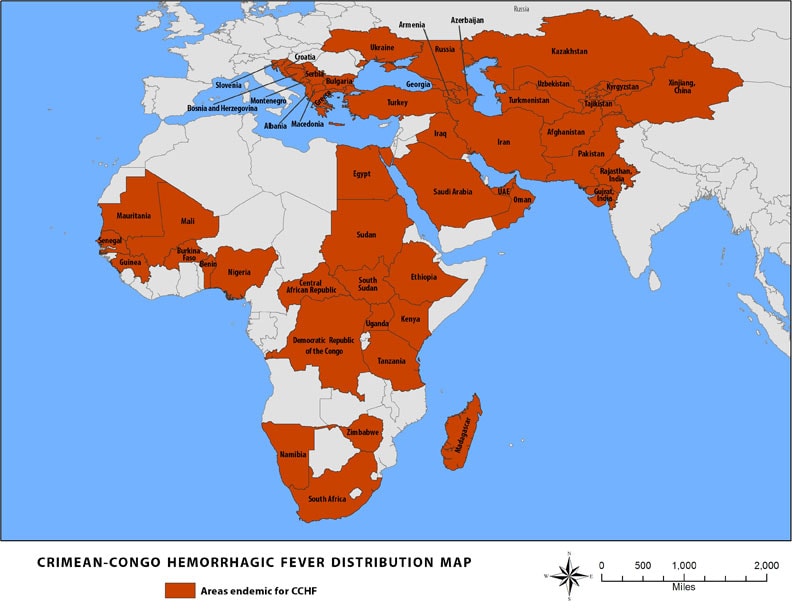
Nairovirus is a tick-borne virus (ticks of Hyalommagenus genus) and has become endemic in Africa, the Middle East, Asia and Eastern Europe - however, infection in Western Europe has remained uncommon. This latest case has raised concerns about a possible spread of nairovirus to Western Europe. 

The primary way that the tick (and nairovirus) spreads is by exploiting the migration patterns of birds, another animal on which the ticks prey.

The signs and symptoms of CCHF (CDC): "headache, high fever, back pain, joint pain, stomach pain, and vomiting. Red eyes, a flushed face, a red throat, and petechiae (red spots) on the palate are common. Symptoms may also include jaundice, and in severe cases, changes in mood and sensory perception." The fatality rate ranges between 9-50%. 

 Distribution Map for Crimean-Cogngo Hemorrhagic Fever. Areas endecmic of CCHF are Azerbaijan, Benin, Bosnia and Herzegovina, Bulgaria, Burkina Faso, Central African Republic, Congo DRC, Croatia,Egypt, Ethiopia, Georgia, Greece, Guinea, Gujart India, Iran, Iraq, Kazakhstan, Kenya, Kyrgyzstan, Madagascar, Mauritania, Montenegro, Namibia, Nigeria, Oman, Pakistan, Rajasthan India, Russia, Saudi Arabia, Senegal, Serbia, Slovenia, South Africa, South Sudan, Sudan, Tajikistan, Tanzania, Macedonia, Turkey,  Turkmenistan, Uganda, Ukraine, United Arab Emirates, Uzbekistan, Xinjiang China, and Zimbabwe
Outbreak distribution map. CDC.

Carolyn Oliver

Sources:
1. CDC. https://www.cdc.gov/vhf/crimean-congo/index.html
2. http://www.healthmap.org/site/diseasedaily/article/crimean-congo-hemorrhagic-fever-spain-new-emerging-disease-western-europe-92716

New Cases of Polio-Like Virus Cause Paralysis in Children

Although the developed world hasn't been worried about polio virus for some time now, the CDC has recently reported an increase in the number of cases of Acute Flaccid Myelitis - a polio-like illness- over the past few months. The illness is exclusively affecting children, with a median age of infection at seven years old. Children with the condition present with fever and headaches that progress to pain and weakness in the extremities as well as in the muscles of the face and throat, which can lead to respiratory failure in the more severe cases. Mimicking polio, AFM damages the spinal cord and can cause permanent paralysis and other neurological deficits.

In 2015, the CDC reported 21 total cases of AFM, yet since August 31st of this year, we've already seen over 50 cases across 24 states. While studies conducted in 2014 seemed to link AFM with a virus known as EV-D68, the CDC has yet to find a single causative agent associated with the development of AFM in these most recent 50 cases. This suggests that multiple viruses could be causing the increase, or that we simply haven't found the specific agent yet.

Despite the increase in cases, the chance of contracting this illness is still very rare. And while a majority of children affected with AFM recover after a mild, flu-like illness, those who exhibit the more dangerous symptoms of the disease can be a frightening reminder that we still have much more to learn.

-Brianna Bolanos

Link to Article: http://www.lifezette.com/healthzette/polio-like-virus-causing-paralysis-children/

Children After Birth Do Not Typically Get Seriously Ill from Zika

For parents all over the world who are worried about Zika virus, there is some good news: children who contract Zika after birth rarely become seriously ill. Since 2015, the Centers for Disease Control and Prevention has followed 160 toddlers and teenagers who have had laboratory-confirmed cases of Zika. Although these children (age ranging from 1 month to 17 years old) were chosen for the study because they were symptomatic, most people who contract Zika do not present any symptoms at all. These children only developed mild illness, with 129 presenting a rash, half of them developing a fever, and a quarter showing reddened eyes. None of the children developed Guillain-Barre syndrome or other neurological complications.

Zika has become infamous for causing birth defects in fetuses, including brain damage, but no lasting injuries were found among this group of children. However, 5 of the teenagers were pregnant when contracting Zika. Sexually active teenagers should also be protected from the virus, and educated on the risks of Zika in pregnancy as well as sexual transmission of Zika.

-Anne Sommer

http://www.nytimes.com/2016/10/01/health/zika-children-illness.html?rref=collection%2Fsectioncollection%2Fhealth&action=click&contentCollection=health&region=stream&module=stream_unit&version=latest&contentPlacement=21&pgtype=sectionfront

Thursday, October 6, 2016

Anthrax-Infected Hippos Affects Zambian Diet

Did you know that hippopotamus meat was edible? I certainly didn't. But, apparently, this "exotic" meat is a "fine game food" (according to famed hunter Peter Capstick). So fine that demand for hippo meat has been causing devastating effects on the hippo population in Congo (see the link below for more details). 

Anyway, back to infectious diseases. In Zambia, an anthrax (bacterium Bacillus anthracis) outbreak is affecting the local hippopotamus population. The problem is exacerbated by the fact that a) it is currently the dry season (April to November), so hippopotamuses crowd around limited pools of water in the heat, increasing chance of transmission and b) there is a drought in Zambia, forcing animals to move further.

Locals are advised to stay away from eating hippopotamus meat AND from handling dead animals. Fortunately, it sounds like the government has the situation under control.

Article: 
http://www.bloomberg.com/news/articles/2016-10-06/hippos-are-no-longer-on-zambian-menus-as-anthrax-threat-rises 
Read more on Hippo Meat: 
http://www.nbcnews.com/id/9980282/ns/us_news-environment/t/taste-hippo-meat-threatens-population/#.V_cb6bWcvqI
http://mentalfloss.com/article/54988/what-11-popular-zoo-animals-taste

-- Sharon Kam

Zika, Zika-related microcephaly, and legal Zika-linked abortions reaches Thailand

Since the beginning of the Zika virus outbreak in 2015, the spread of the Zika virus has been closely watched by governments and health agencies all across the world. However, despite efforts to contain the virus, the vector-borne disease has moved from South America to North America and, more recently, Asia.

Last Friday, Thailand reported two cases of babies with Zika-linked microcephaly- one born, and one due to be born soon. Today, another case of microencephaly was confirmed by ultrasound. While Thailand has recorded 400 cases of Zika virus since January, these are the first indications of microcephaly in babies born to Zika-infected women in Thailand. The spread of Zika in Asia has not been limited to Thailand; widespread transmission of the virus has also been seen in Singapore, and many other Southeast Asian countries are at risk. 

The cases of microcephaly have spurred lengthy deliberation among doctors in Thailand, who yesterday announced that pregnant women infected with Zika virus can legally undergo abortion. This makes Thailand the first Asian country to modify guidelines.

Articles:
http://www.ibtimes.sg/thailand-makes-zika-linked-abortions-legal-fears-over-microcephaly-rise-3740
http://news.thaivisa.com/thailand/thai-health-min-number-of-zika-patients-approaching-400/155856/
http://www.cnn.com/2016/09/30/health/zika-microcephaly-cases-thailand/

 -- Sharon Kam

Genetically Engineered Cows: New Way to Combat Disease?

With the Ebola outbreak, various medical professionals turned to human plasma from individuals that had survived Ebola as a source of combatting Ebola in infected individuals. However, one of the problems with such approach is quantity of plasma available. An American startup, Sioux Falls-based SAB Biotherapeutics, however, has come up with a possible solution--genetically engineering cows to become “plasma factories.”  

The way that the cows become engineered is that the scientist will knock out a section of genes in the cows and replace them with a human artificial chromosome that will allow for human antibody production. After the chromosome is inserted, the cows will get vaccinated with a target disease antigen that will help lead to the production of antibodies, which the scientists can then collect to create a therapeutic drug. The cows will be able to produce between 300-1,000 more doses per month compared to a human, which could be very useful for future health outbreaks.

While the antibody production will take under 3 months, one of the main challenges will be the cost. A gram of antibodies is around $2,000, which is a fairly hefty price considering the target countries may tend to have weaker economies than the US. However, the WHO has recognized this interesting approach as a possible manner of responding to disease outbreaks so this may turn out to be really effective in future health events.


--Jeanette Rios